
The following texts are edited transcripts from presentations made during our Roundtable on AI Melancholy, held at our space on June 7th: “this month’s facilitated discussion will explore the tech economy’s uneven distribution of gains from its recent boom... as well as the social relations AI presupposes and strives to produce.” From this session also came Amogha Sahu’s text “The Problem of Brainrot”, which we published last month.

Managing Social Tensions: An Analytic for AI
by Tony Iantosca
We want more from the ongoing discussion about AI than arguments that our humanity is being lost, or that this technology is simply the culmination of rampant finance capital. Such thinking only leads us back into discussions that take a certain model of human mastery as something that must be defended. I want to leave behind a binary framing of the topic – one that falls outside political economic discussions, important as those are; as well as approaches that simply reject AI in the name of a naïve humanism.
Humans and the tools we have created, inextricable from the beginning, have never been reducible to moralistic judgments that assume stable models of humanity, or a static vision of a society that many of us would like to see transform unrecognizably.
Andre Leroi-Gourhan’s thought gives us a useful alternative. In Gesture and Speech, he starts from the premise that human societies are collective social organisms. If that is true, one cannot privilege either the human or the technical. There are two reasons for this: first, that the human and the technical object mutually condition each other and determine a set of shared capacities and potentialities (see Gerald Raunig’s chapter “Abstract Machines” for more). Secondly, humans and machines amount to no more than organs of the larger organism called society, human civilization, but without being fully subordinate to that organism.
In the cultures he has studied, Leroi-Gourhan argues that rudimentary graphic representations – early rhythmic forms of writing showing up in patterns of dots – were a support medium for orality or incantations. The face, the voice, and the hand have all evolved in conjunction with the human’s capacity for making these marks and the tools used to make them, through which an already-existing practice (incantation) finds new forms of expression and is in turn transformed. Similar dynamics play out with the cave paintings to which he refers, with a slight but important difference: pictographic representations are evidently inadequate to the conceptual and linguistic capacities of the humans who produce them. The technical support always presupposes linguistic or cultural meanings that exceed, in this case, pictographic representation. This is a tension that persists throughout our historical relation to technology, one that does not seek resolution since that would arrest the generative force the tension produces.
The main question that arises for me from this mismatch between technology and cultural meaning regards the excess meanings, desires, affects, or potentialities that are set free when the technical object proves inadequate.
Depending on the relations of power in our society, this excess will be re-encoded in new attempts at equivalency –capital, political economy, algorithmic code – or representation – the state, but also individuations, identities, etc.. But an alternative path exists, one in which liberatory projects and forms of life collectively decide both the technical support for this excess, and its elaboration and propagation. The excess, in other words, can weave itself into our lives in ways that facilitate the collective elaboration of new encounters that do not falsely stabilize and hierarchize the social field.
One way to understand what is meant here by excess is to relate it to that which exceeds encoding and predictability. The predictable, the statistically likely in the algorithms that power AI, is both assumed and produced by these social machines. This process is one which requires a progressive paring down of the statistically unlikely, relegating it to irrelevance, all while assigning the information that leads to reproducible results—the outputs—signs of equivalency and exchangeability. When we object to AI, our critiques must strike at the dimensions of its social positioning that reflect a broader epistemology, a broader orientation towards the world: that it is reducible, representable, non-singular, exchangeable, and fully knowable and predictable. From the perspective of those who control AI, the only horizon that can emerge from the social tensions Leroi-Gourhan highlights is one in which these tensions are reduced and made manageable–and enormously profitable–by social machines.
Such technology, as we have seen, does indeed alter the human, but this is not a useful basis upon which to protest AI, since alterations in the human are always already ongoing. To know the manner in which this alteration happens is what’s important, and to grasp that we must interrogate precisely the world-making capacities of any technology – capacities that are linked intimately with underlying assumptions that this technology activates.
Equally important will be to find the elements of AI that hijack otherwise revolutionary elements of the linguistic and extralinguistic field. Specifically, I am thinking of the concept of the a-signifying semiotic, inspired by Felix Guattari and, later, Maurizio Lazzarato. The a-signifying semiotic is a sign that acts on the world by escaping or evading the codes of representation or normal signification. Examples of this sign would be genetic code, interest rates, or musical notation, signs that intervene and command reality outside communicable messaging.
This is precisely what algorithmic code accomplishes in a complex interplay with the production of images, language, and information. It manages the tensions between representation, language and equivalency on one hand, and desire, affect and social potentialities on the other. It is as if the entire field of the general intellect has been enclosed with barbed wire ringing the data centers where the lights never go out.
But the revolutionary use of the a-signifying sign should be clear since militants would finally have in their hands a tool that mobilizes energy and force without the traditional encodings, hierarchies, and economies of power. Such a mobilization cannot happen without an increase of the tensions discussed above, tensions that are currently managed by algorithmic code.
How can we get inside these tensions in such a way that the excesses can be collectively managed rather than encoded by corporations? What potential uses of a-signifying power exist in the social field that we can, in turn, hijack towards revolutionary horizons? How do we build new orientations towards the world around us that escape the subjectivizing powers of exchange and equivalency, predictability and representation?
Perhaps the answer is itself outside the scope of the question, outside the bounds of these ruminations – that is to say, outside what can be foreseen. We only know that every uprising catches us all off guard, and scrambles the divisions between emotion and intellect, self and other, temporal and spatial organizations. This is what an uprising shares with the a-signifying semiotic in the social organism’s viral response to the arrest of its historical potentiality.
The Wrong Side of the K-Shaped Economy
by Eric
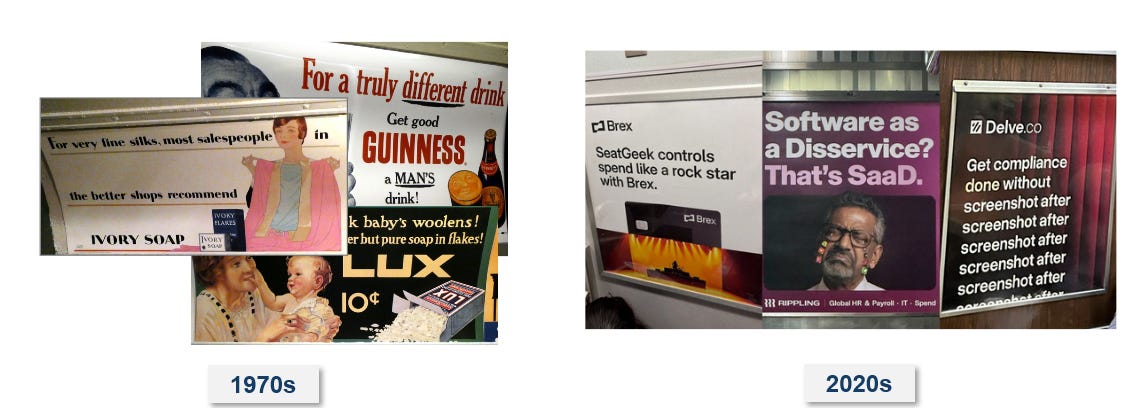
If you’re a frequent rider of the New York City subway, you’ve probably noticed the bizarre trend of enterprise software ads being plastered all over most train cars. Over the past few years, one of the advertising industry’s key battlegrounds has become overrun with venture capital-backed tech unicorns, peddling products that sound like absolute gibberish to the vast majority of captive riders. After all, what are the odds that the CTO of a Fortune 500 company decides which vendor to replace their ERP system with based on a subway ad?
The shift in target demographics for subway ads away from general consumers and towards corporate executives is a strong indicator of what has been dubbed the “K-shaped economy,” a term that has gained recent prominence to refer to our current malaise. The term refers to a highly polarized system in which macroeconomic gains are disproportionately distributed to a small, wealthy elite – i.e., tech magnates like Elon Musk or Larry Ellison – while the rest of the population experiences stagnation.
Over the past year, the existence of a K-shaped economy has been affirmed by countless Fortune 500 CEOs and top economists alike. Last December, then-Federal Reserve Chair Jerome Powell, when asked about the topic, acknowledged that “if you listen to the earnings reports for consumer-facing companies that tend to deal with low- and moderate-income people, they’ll all say that we’re seeing people tightening their belts, changing products that they buy, buying less and that sort of thing. And so [the K-shaped economy] is clearly a thing.”
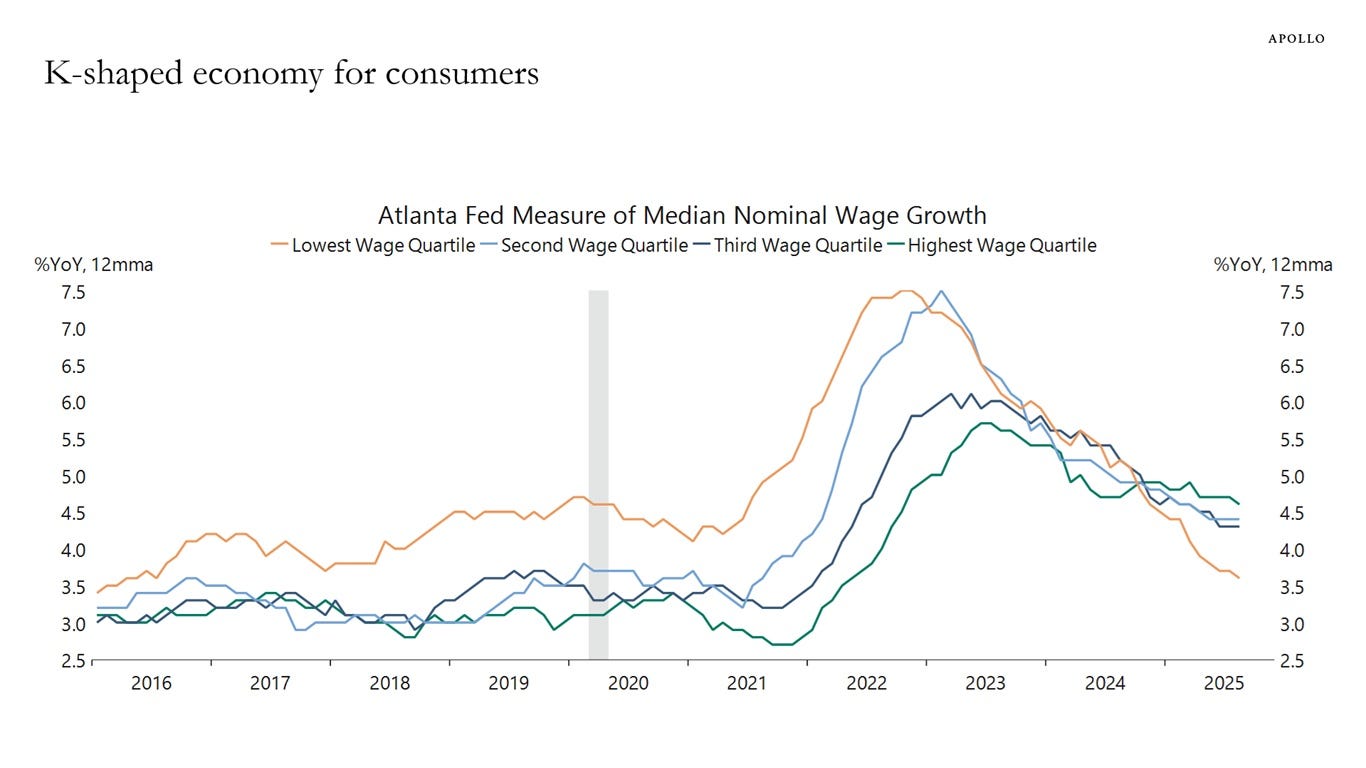
Recent data illustrates the existence of a K-shaped economy quite succinctly — the graph above compares the growth in median nominal wages between each wage quartile before and after the pandemic. It reveals that while the lower half of earners saw their wages rise the fastest from 2016 to 2023 – thanks mostly to low interest rates and COVID-era fiscal stimulus driving strong labor market growth – this trend had reversed by late 2024.
Here it’s worth noting that the wage growth data shown does not account for inflation – which peaked at 8% in 2022 – offsetting most of the gains enjoyed by the lower half of earners during the pandemic. Additionally, economic growth and wage growth during this time period pales in comparison to the rate of return on capital, a phenomenon that French economist Thomas Piketty famously argues is the root cause of inequality. Since 2021, the S&P 500 – the index which tracks America’s top 500 publicly traded companies – has grown at an average rate of 11.3%, far exceeding the peak rate of wage growth for any quartile in that period.
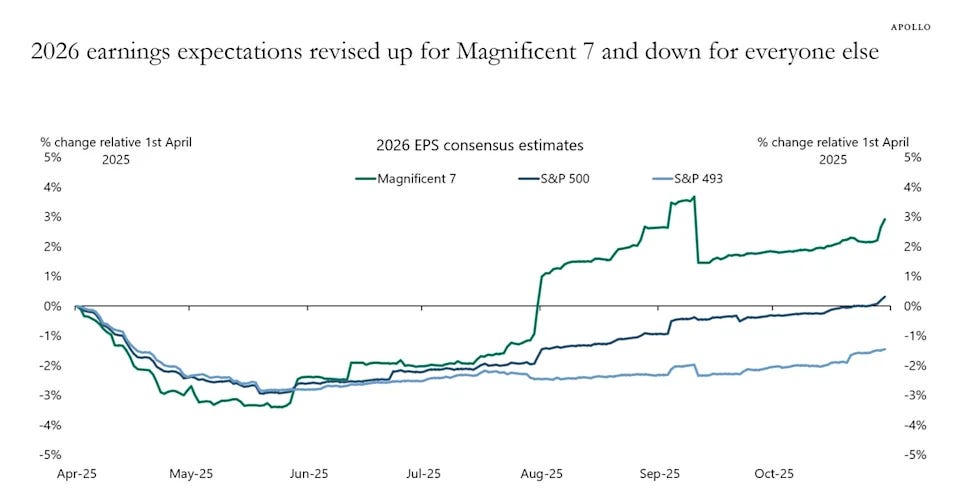
By the summer of 2025, signs of the K-shaped economy began to show in the stock market as well, driven mostly by astronomical AI stock valuations and explosive data center investment. The graph above, which tracks changes in 2026 profitability (EPS) expectations for publicly-traded US companies over the course of 2025, illustrates the growing stratification between America’s top industries. While analysts had a generally negative outlook for the overall S&P 500 throughout most of 2025, following Trump’s “Liberation Day” tariffs in early April, a small subset of companies managed to single-handedly neutralize this macroeconomic pessimism by the end of the year. This was due mostly to the outsized role of the AI industry in America’s recent economic growth, as indicated by the Magnificent 7 – composed of Meta, Amazon, Google, Microsoft, Tesla, and Apple – which alone represent 34% of the entire S&P 500. After removing the Magnificent 7, the remaining companies, denoted as the “S&P 493” in the graph, were expected to contract by as much as -2% in terms of 2026 profitability.
These trends in the stock market reflect the substantial degree of polarization within our current economy. Companies that have traditionally relied on the consumer segment face significant macroeconomic headwinds, driven by a variety of factors: slowing population growth, growing inequality, supply chain shocks and tariffs. Many business executives are responding to these adverse trends by pivoting their product offerings towards enterprise markets instead, especially in AI-adjacent sectors where capital is abundant and investment remains high.
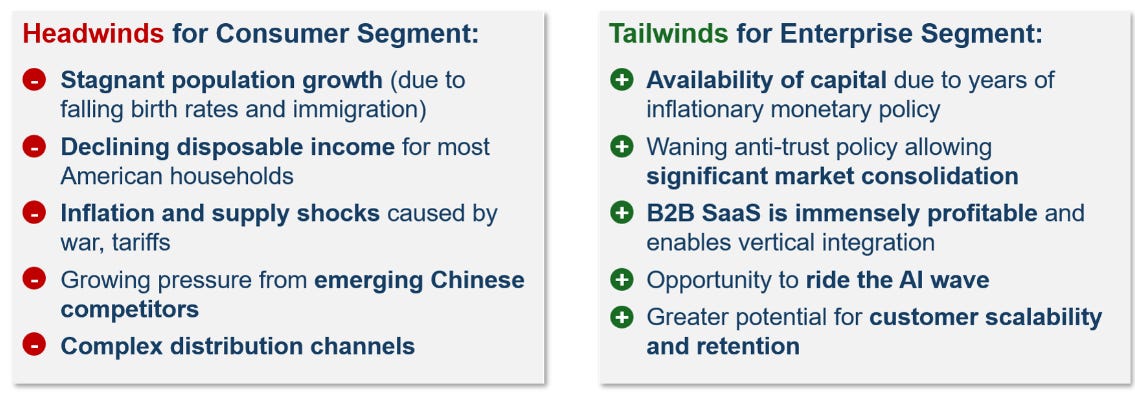
Take the example of HVAC, where leading equipment manufacturers like Trane and Carrier are experiencing strong revenue growth in spite of slowing residential demand, primarily attributed to skyrocketing demand for energy-efficient data center cooling systems and high recurring revenues from subscription-based “Cooling-as-a-Service” business models. Some companies have even elected to exit the consumer segment entirely to jump on the AI bandwagon; earlier this year, struggling sneaker company Allbirds announced that they are exiting the footwear industry to purchase computer hardware and focus on AI services instead.
The abandonment of consumer segments has serious implications for the general public, which have already manifested across several industries. Perhaps the most notable example is with semiconductors, where a major shortage of core computer parts such as memory chips and graphics processing units (GPUs) have resulted in manufacturers suspending production of consumer hardware altogether to satisfy the needs of enterprise clients. This has huge spillover effects for consumer electronics, with the price of consumer DRAM chips increasing by 500% over the last 12 months alone. Even industry titans like Apple, who historically held strong influence over semiconductor manufacturers as their single biggest customer, are not immune to the hardware shortage and must now scale back production of their own products.
Due to the exorbitant start-up costs required to establish semiconductor plants, only a handful of companies have been able to capitalize on the AI boom. In the case of DRAM, just three companies control roughly 90% of the global market, including South Korea’s SK Hynix and Samsung – these two companies alone account for nearly 50% of the entire South Korean stock market’s valuation, resulting in a K-shaped economy even more extreme than in America.
Recent events in South Korea serve as an omen for what is to come in America. Earlier this August, the Korean stock market plummeted by nearly 40% from its all-time high just two months prior, driven largely by a global decline in investor confidence regarding the AI industry. This crash was exacerbated by the sheer volume of highly leveraged, retail investors – everyday people investing with borrowed money – who had placed their entire life savings (and more) in the faith of the market.
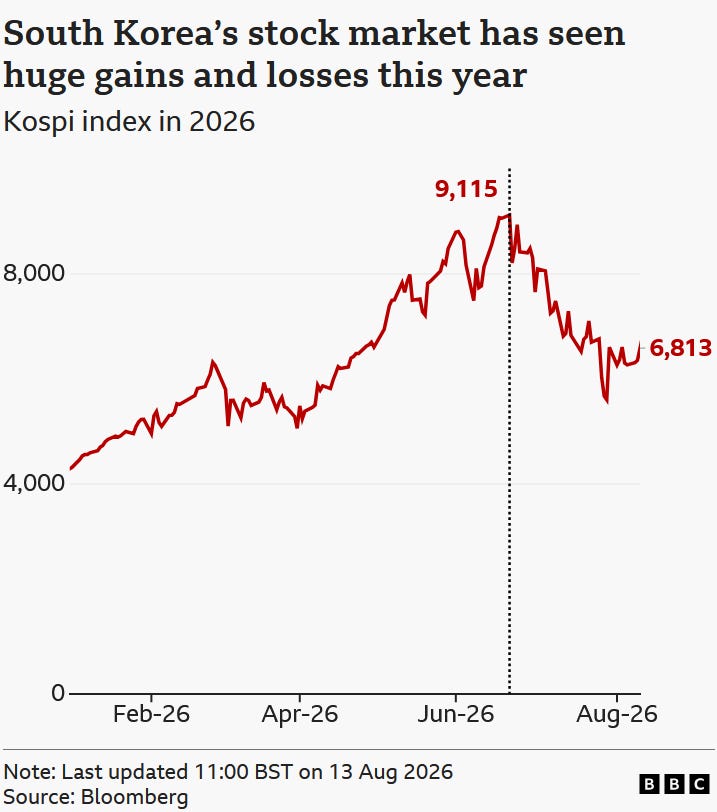
As the market tumbled, news headlines spread around the world about the devastation being inflicted upon the South Korean people, who are already battling one of the most severe cost of living crises in the world. The country ranks among the top 13 worst for housing affordability with a housing price-to-income ratio of 22.2 – for reference, the United States ranks near the bottom with a ratio of 3.3. For the struggling Korean middle-class, the practice of gambling one’s entire life’s savings on highly leveraged AI index funds is a rational risk stemming from financial nihilism. After all, what’s the harm in putting it all on AI if people have no chance of affording a home in their lifetime anyways?
It shouldn’t surprise anyone that gambling has filled much of the void left behind by consumer products in the advertising landscape. Attend any professional sports game today and you’ll be bombarded with a plethora of gambling mediums: sportsbooks, 50/50 charity raffles, stock brokerage apps, index funds, and prediction markets are among the products being promoted at most ballparks on a nightly basis. At a time when wages are stagnant and purchasing power is declining, gambling feels like the only mechanism through which the working class could possibly catch up with the wealthy.

Of the few consumer oriented products still being marketed on the subway, an increasing share of them are targeted solely towards wealthy demographics. Chase Sapphire Reserve, a luxury travel credit card with an annual fee of $795, selectively targets wealthy commuters by advertising prominently in high-income neighborhoods like SoHo and Hudson Yards. Recent trends in the travel industry are yet another key indicator of the K-shaped economy and its ramifications, which are even being highlighted in official government reports. The latest FAA Aerospace Forecast, which summarizes market trends and projections for the American aviation industry, states the following:
“In 2025, the impacts of the K-shaped economy became more apparent as the financial performance among different types of carriers widened. Macroeconomic uncertainty seemed to weigh most heavily on domestic leisure travelers, the segment [low-cost carriers, i.e., Frontier or Spirit] generally target, as they pulled back, substituting destinations or modes of transport, squeezing margins of those carriers. On the other hand, the income cohort that has seen strong wealth gains from equities and housing valuations were bolstered as they made long-haul international trips and travelled in premium cabins [i.e., premium economy or business class]. The large network carriers that have segmented their markets more fully, benefited from this cohort in the upper arm of the ‘K’. As noted above, [low-cost carriers] are working to segment their products but doing so and overcoming entrenched “no-frills” perceptions will take time.”
At a time when domestic short-haul travel is falling due to a cratering middle class, demand for ultra-expensive business class seats on long-haul flights is skyrocketing. For reference, while a round-trip ticket from New York to London in economy class currently costs around $650, that same itinerary sells for over $7,000 in business class. Because business class can generate up to ten times the revenue of economy while only taking up three or four times as much cabin space per seat, America’s major carriers – United, Delta, and American Airlines – are all rushing to refit their aircrafts with “premium-heavy” seat configurations just to keep up with rising demand from high-spenders.
If there’s one key takeaway from the history of technology, it’s that with each innovation comes a clear set of winners and losers. What makes the AI boom unique is just how disproportionately small the list of winners seems to be compared to the exceedingly long list of losers – any company that can’t find a way to serve either data centers, large enterprises, or the wealthy will inevitably find themselves in the latter category. This includes most of the S&P 493, as demonstrated by the McDonald’s CEO who, during an earnings call earlier this year, expressed that the macro environment and consumer sentiment are “certainly not improving, and it may be getting a little bit worse.”
It’s worth noting that much of the analysis and discourse surrounding the K-shaped economy stems from investment firms and financial institutions – including Apollo Management, the private equity firm which produced the graphs shown earlier. Even the top beneficiaries of this growing wealth inequality are starting to recognize its perils as they realize that their wealth, and the American economy as a whole, is contingent on the uninhibited growth of consumer spending. The US is famously a consumer-centric economy – personal consumption represents 68% of GDP in 2026 – and consistently ranks among the highest for advanced economies. This begs the question: what happens when the consumers are all dead?