

This text builds upon Woodbine’s Roundtable on Municipal Socialism held earlier this year, and is part of an ongoing series on America’s infrastructure gap. If you’d like to learn more, listen to episodes #31 and #36 of the Woodbine podcast, which cover Ezra Klein and Derek Thompson’s Abundance book, as well as Hans Widmer’s latest book on urban ecology.
Municipal Socialism and Infrastructure
On October 1, 2025, in the midst of the longest full government shutdown in American history, the White House announced the freezing of nearly $18 billion in federal funding for both the Second Avenue Subway Phase 2 and the Hudson Tunnel Project, two of New York’s most crucial infrastructure projects. Officially, the US Department of Transportation cited “unconstitutional DEI principles” within the contractor selection process as grounds to suspend funding. However, the Trump administration also not-so-subtly insinuated that the funding freeze was intended to pressure House Minority Leader Hakeem Jeffries and Senate Minority Leader Chuck Schumer, both of whom represent New York, into passing an appropriations bill that would end the government shutdown.
Although the Trump administration’s nonsensical claims were ultimately struck down in court months later, with funding for both projects being restored by June 29, the damage had already been done. By February 6, after exhausting its financial reserves, the Hudson Tunnel Project was forced to fully suspend all construction activities, putting nearly 1,000 people out of work before funding was temporarily restored on March 10. The freeze also jeopardized the tunnel’s target completion date of 2035 by forcing the project to pause contractor procurement during the nine-month funding lapse.
The Second Avenue Subway and Hudson Tunnel Project are just two of countless infrastructure projects that have been derailed by the second Trump administration. Around this same time the Department of Energy terminated $7.6 billion in federal grants supporting clean energy projects, including $500 million earmarked for New York recipients. This new de-federalist platform spells the end of a century-long era of Congressional infrastructure investment, during which national taxpayer dollars served as an instrumental funding source for America’s most critical public works projects.
The History of Federalist Infrastructure
From the 1930s until today, the American government has operated under the doctrine of John Maynard Keynes, who during the Great Depression argued that significant fiscal stimulus – mainly through investments into public works – would create the jobs needed to recover from economic downturns. President Franklin D. Roosevelt was the first to put this theory into practice at scale, making key infrastructure projects such as the Hoover Dam central to his New Deal agenda to combat unemployment in 1933.
Federal investment in infrastructure peaked when President Dwight D. Eisenhower established the Interstate Highway System in 1956, the largest public works project in human history at that point – early on, the federal government subsidized up to 90% of all interstate highway construction costs. Infrastructural investment also played a significant role in the government’s response to both the 2008 financial crisis and COVID-19 pandemic, with President Barack Obama investing $105 billion and President Joe Biden investing $550 billion respectively, although much of the latter’s funding has since been suspended by the second Trump administration.
The Funding Gap
In the wake of widespread funding cuts that have severed tens of billions in federal grants spanning virtually all sectors, municipalities throughout the country are scrambling to find alternative funding models to repair our nation’s crumbling infrastructure. A half-century of neoliberalism has crippled the ability for state and local governments to invest in long-term, self-sustaining infrastructure programs that proactively address society’s needs before they become crises. Instead, the country has become dependent on sporadic federal subsidies, generally coming in only after a major recession, to enable critical projects that are already decades overdue.
Every year, the American Society for Civil Engineers (ASCE) releases a report card for the nation’s infrastructure needs; in 2025, they estimated that America would need an additional $3.7 trillion in investment, on top of what Congress is already funding, to achieve a state of good repair. In their explanation of this massive funding gap, ASCE argues the following:
“Sponsors of infrastructure projects will need to innovate and look to diversify funding and financing sources beyond federal spending to close this investment gap. A typical capital stack for an infrastructure project includes different types of funding and financing to fund [a] project’s development, construction, and operations… federal and state government contributions provide project funding and help to attract investment to projects but typically cannot provide the sole source of financing.”
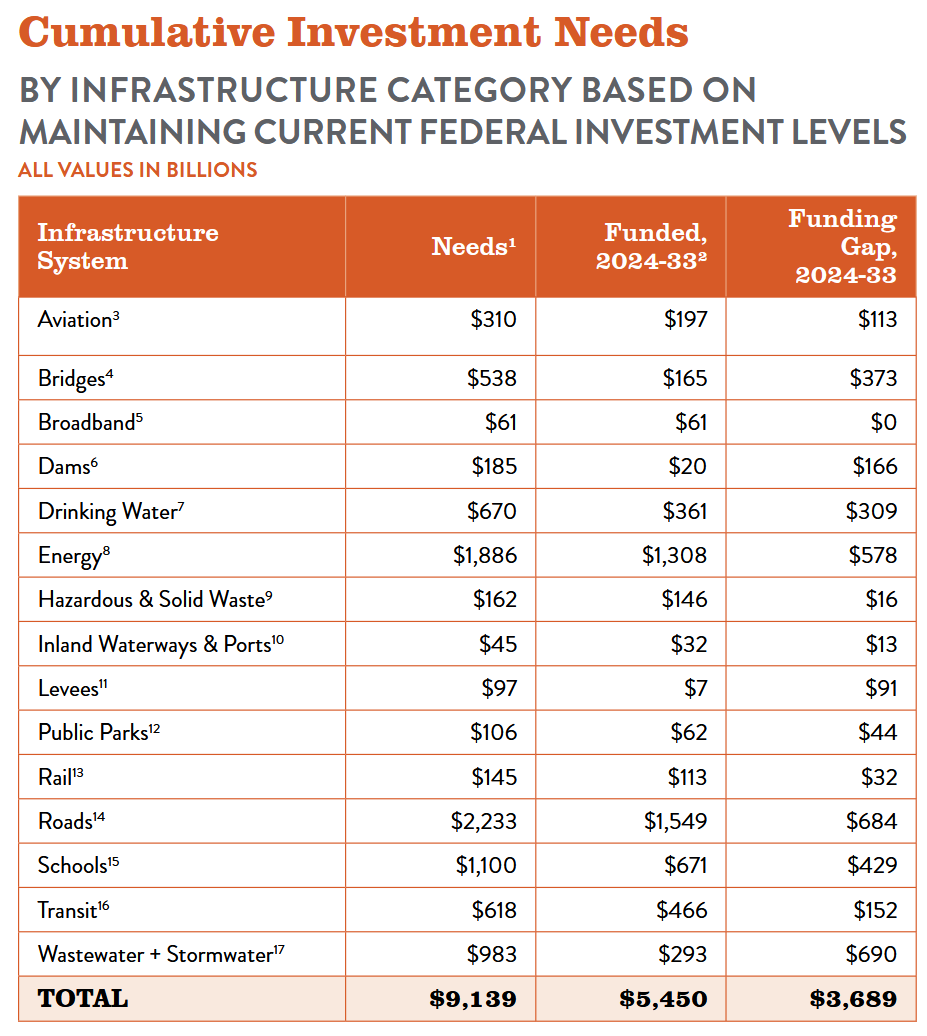
Breakdown of America’s $3.7 trillion infrastructure funding gap. Source: ASCE (2025)
Despite what staunch neoliberals like Gavin Newsom and Ezra Klein claim, the underlying cause of this funding crisis has little to do with overregulation or NIMBYism. It is the result of a broken system deliberately designed to prevent regional governments from collecting the revenues – either through direct taxation or user fees – needed to support the construction, operation, and maintenance of vital infrastructure. Consequently, municipalities are highly dependent on state and federal subsidies to fill the funding gap, creating an incredibly fragile system where the health of a city’s core infrastructure is contingent on the cooperation of higher levels of government.
Thanks to DOGE and the 2025 government shutdown, we are now witnessing the collapse of this funding model in real time. Over the past few years, nearly every public transit system in America has had to battle the same issue: an impending fiscal cliff resulting from the end of COVID-era operating subsidies by the federal government, exacerbated by a substantial decline in ridership post-pandemic.
This November, voters in the Bay Area will decide whether to bail out Bay Area Rapid Transit (BART), or allow it to sink towards financial insolvency. Despite serving several of America’s wealthiest municipalities, the transit agency currently faces a structural budget deficit of $375 million starting in fiscal year 2027. In the case that voters reject SB 63 – a ballot measure which proposes a one-cent sales tax in San Francisco County, and a half-cent tax in the rest of the region – BART estimates that it will need to cut train service by up to 70% to achieve a balanced budget, crippling a transportation network that currently serves 180,000 daily passenger trips across five counties.
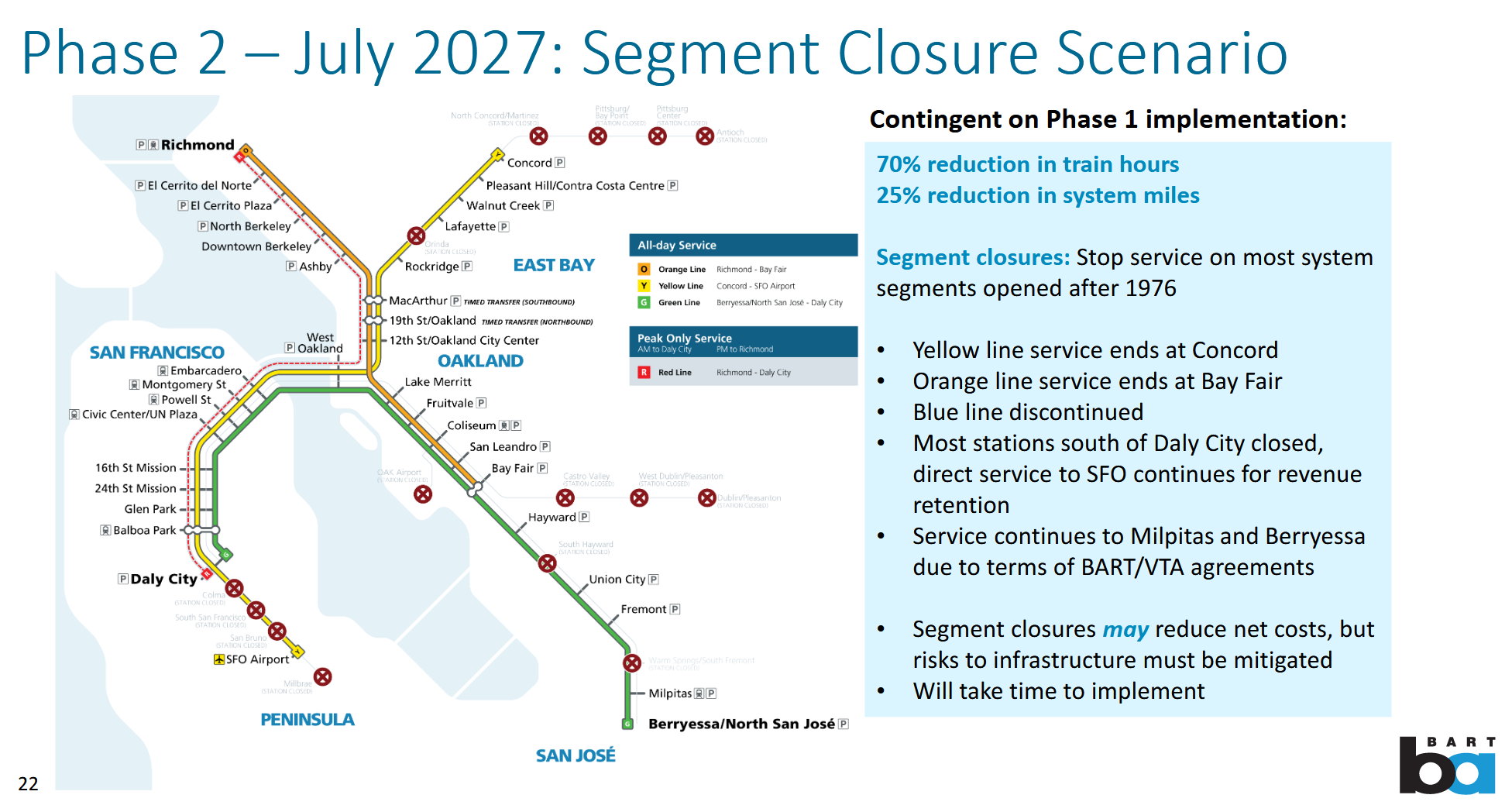
Details of proposed 70% BART service cut if SB 63 fails.
Source: BART Board Workshop (February 12, 2026)
Taxation
Unsurprisingly, the only public transit systems in the US that have managed to avoid this fiscal crisis are those who already had dedicated funding sources prior to the pandemic, or who have since passed funding measures at the state level. One such example is in Seattle, where a mix of sales, property, and motor vehicle excise taxes means that Sound Transit is able to not only cover its operating expenses, but also fund a massive system extension for its Link light rail system. These investments have been a resounding success for the region, with Link ridership skyrocketing to 175,000 daily boardings – up 110% from pre-pandemic levels – after the completion of its $3.8 billion Line 2 project earlier this year. At a time when most transit systems nationwide are in a state of crisis, Seattle is prospering.
While direct taxation is the most obvious funding source for infrastructure, it famously has its limitations; not only are taxes incredibly unpopular, they generally must also be voted on and approved by the state government, even if they apply only to taxpayers within that specific municipality or region. In search of other options, municipalities across the country are increasingly deploying a mix of both traditional and alternative financing methods, many of which are already commonplace elsewhere in the world.
Self-Financing
The Port Authority of New York and New Jersey (PANYNJ) is leading this transition, serving as a definitive example of how massive public works projects can be funded without reliance on direct taxpayer funding. PANYNJ is a joint venture between the States of New York and New Jersey, responsible for operating a wide infrastructure portfolio that includes all six bridges and tunnels connecting NYC and New Jersey, the Port Authority Bus Terminal, the PATH, and the region’s six airports. Shockingly, PANYNJ does not receive any operating subsidies from either state or the federal government, instead relying on operating revenues through airport landing fees, tunnel and bridge tolls, and commercial real estate leases. Through these diversified sources, PANYNJ generated $7.3 billion in operating revenues in 2025 alone.
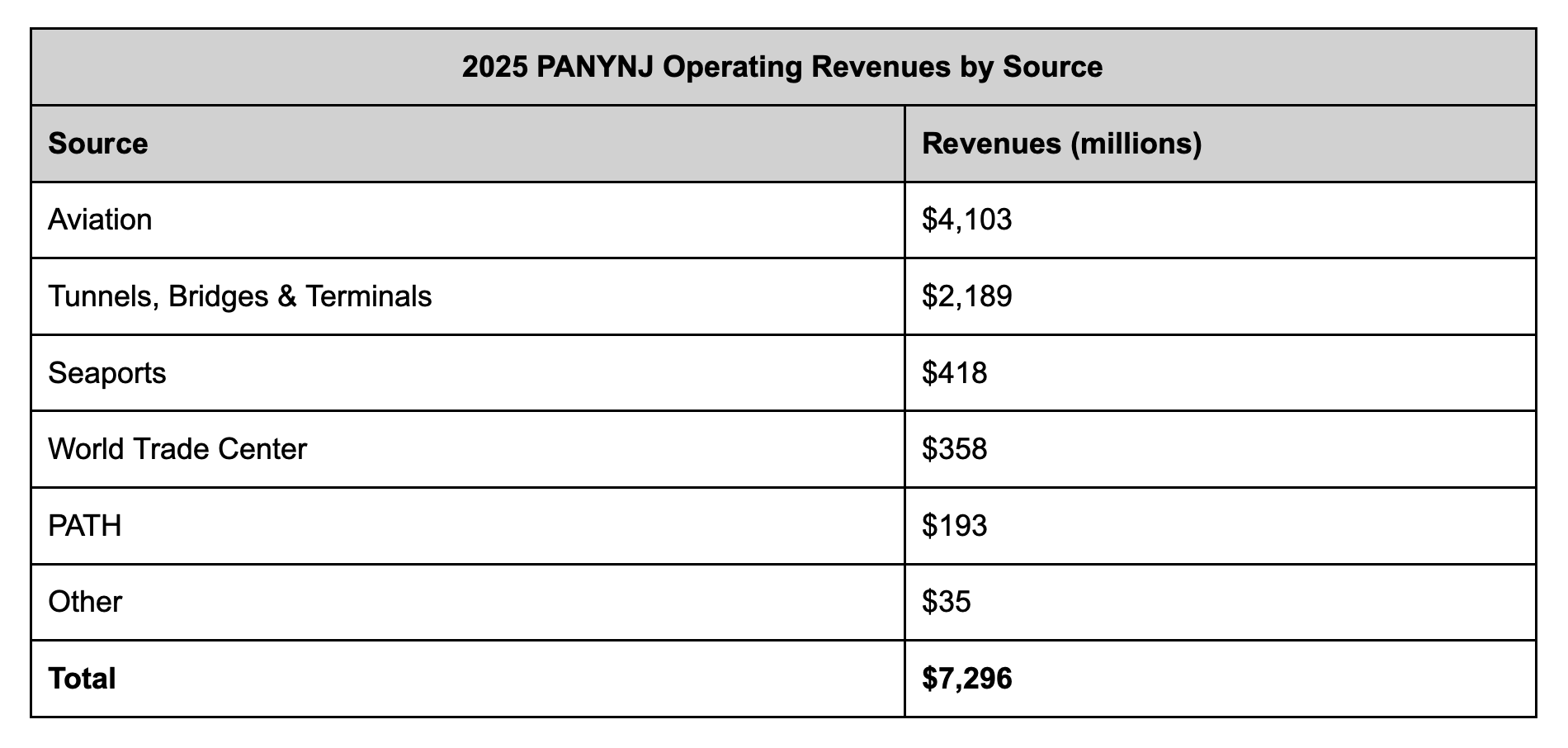
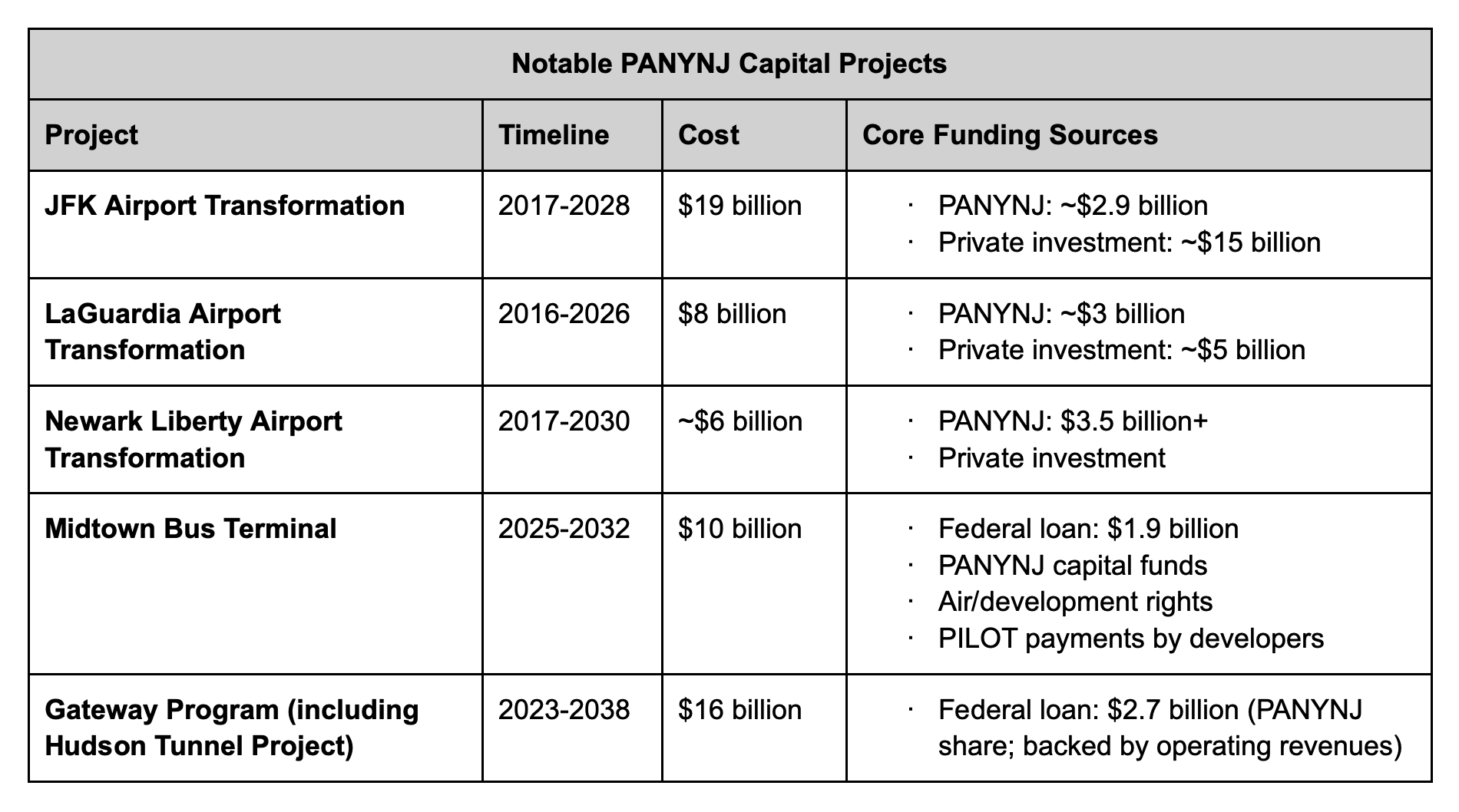
Last year, PANYNJ brought in a net income of $1.2 billion from its operations; because PANYNJ is a government agency, the profits generated from their operations are not paid out to shareholders, instead being invested into the construction and maintenance of infrastructure. Currently, the agency is advancing a $40 billion+ portfolio of capital projects that includes renovations of all three major airports (Newark, JFK, and LaGuardia) and the Port Authority Bus Terminal, financed almost entirely through current and future operating cash flows.
Public-Private Partnerships (PPPs)
Notably, PANYNJ has managed to finance a breadth of megaprojects without relying on either state or federal grants. In addition to traditional financing methods – bond issuance and capital budget appropriations – PANYNJ is relying heavily on Public-Private Partnerships (PPPs) to fund construction of projects with the highest potential for profitability. Through PPPs, the agency is able to offload the financing and associated risks of projects onto private investors, in exchange for either an equity stake in the completed asset or a flat fee paid by the PANYNJ per user.
Because of the aviation sector’s strong growth and diversified revenue sources – landing fees, retail leases, and parking fees – airports are prime candidates for financing through PPPs. Despite being commonplace throughout most of the world, especially in Europe and Asia, PPPs are surprisingly rare in the US. In fact, PANYNJ is one of only a handful of American transportation agencies that have deployed this method at scale, with PPPs still being illegal in several states.
Although the term might be frightening at first, PPPs are neither inherently good nor bad. As with any other financing model, the efficacy of PPPs depends on the specific needs of the public, the funding sources available, and the fairness of terms negotiated with the private partners. The term is also incredibly broad: some PPPs, like Build-Own-Operate-Transfer, transfer ownership of the asset and its cash flows to the private partner; whereas others, like Design-Build-Finance-Operate-Maintain, offload virtually all project risks to the partner while preserving public ownership of the asset.
Public Pension Funds
Up north, a different type of PPP is finding success by replacing the role of private investors with public pension funds instead. Next year, Montreal anticipates full completion of the REM, a 42-mile rapid transit system that employs the most modern rail technology seen in North America today. What makes the REM especially unique is that the majority of its $6 billion price tag was funded by La Caisse, a government entity that manages several of Quebec’s public pensions, in exchange for a flat fee paid by the local government per ride.
Unlike in America, where public pension funds invest mainly in traditional financial instruments such as stocks and bonds, Canadian pensions are managed internally with a strong emphasis on alternative assets such as private companies, real estate, and infrastructure, resulting in portfolios that more closely resemble that of a private equity fund than their American counterparts.
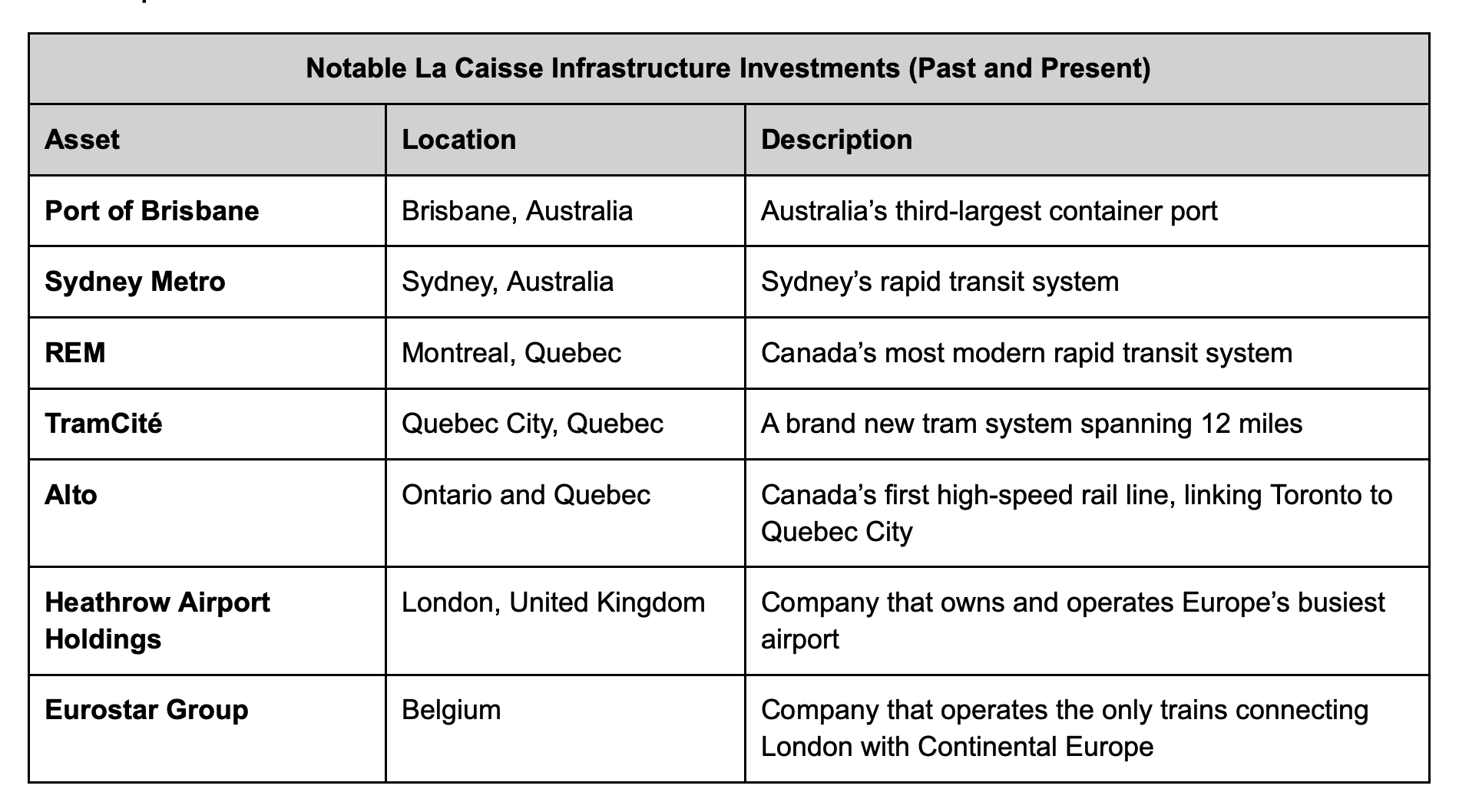
As part of Prime Minister Mark Carney’s nation-building agenda, the Government of Canada is placing growing pressure on its massive public pension funds – the top 8 of which collectively manage nearly $2 trillion in assets – to invest into domestic infrastructure projects rather than overseas. This quasi-PPP strategy provides all the benefits of alternative financing whilst also ensuring that the nation’s public works remain in the hands of the Canadian people.
State Infrastructure Banks
While America has yet to employ a public financing strategy as robust as La Caisse, state infrastructure banks are becoming increasingly common. In 2013, the New York State Energy Research and Development Authority (NYSERDA) launched the NY Green Bank, a state-sponsored investment fund that has committed over $2.7 billion in clean energy projects so far. By collaborating with private investors, NYSERDA is able to attract capital for ambitious clean energy projects that would otherwise be commercially unviable, ranging from energy storage and clean transportation to building electrification and community solar.
Municipal Broadband Networks
In addition to clean energy and transportation, telecommunications is another key sector ripe for public investment. Thanks to decades of extensive lobbying, America’s top internet service providers (ISPs) have ensured that their industry is not regulated in the same vein as public utilities, enabling them to establish and protect regional monopolies in rural areas where they can then charge inflated rates for sub-standard service using antiquated copper cables. Through the $42 billion Broadband Equity, Access, and Deployment (BEAD) program, the Biden administration sought to end this “digital divide” by subsidizing the construction of modern fiber optic networks across all underserved areas, although this program has since had nearly half of its funding revoked by the second Trump administration.
While most states awarded the majority of their BEAD funding to the top ISPs – Verizon, AT&T, and Comcast – New York was one of very few to invest into building community-owned fiber networks. Under the ConnectALL program, the State has awarded over $295 million to municipal utilities and other public entities across 20 different projects, with the goal of connecting over 95,000 rural households and businesses with over 2,500 miles of fiber optic cable. Although ConnectALL is focused mainly on rural areas, the program also awarded $898,000 to NYC Mesh earlier this year to connect low-income households in underserved areas to their community-run network.
In addition to being publicly owned, municipal recipients of ConnectALL funding are required to open their fiber networks to all internet service providers, ensuring full and fair competition that will drive prices down, while providing rural communities with long-lasting revenue-generating assets. Placing fiber networks under the ownership of public utilities enables more efficient construction and maintenance through the use of a “Dig Once” policy, where fiber optic cables are installed whenever land is excavated for other utility projects.
Several other regions across America, including red states, have already implemented municipal fiber networks to great success. In 2010, EPB, the public utility company in Chattanooga, Tennessee, leveraged federal grants and bond issuance to install a 9,000-mile fiber network and became the first ISP in America to offer gigabit-speed connections to all customers. Another trailblazer is Utah, which has built a regional open-access fiber network connecting 20 different cities across the Salt Lake City region. Unfortunately, because of the sheer political influence waged by incumbent ISPs, publicly owned broadband networks are still heavily regulated – or outright banned – in over a dozen states.
Our Municipal Socialist Future
These projects represent just a handful of examples from the breadth of innovative financing models employed throughout North America in recent years. Although these strategies alone won’t get us anywhere close to solving the $3.9 trillion infrastructure investment gap, they do underscore the importance for municipal governments to develop long-term financial models that establish self-sustaining assets. For municipal socialism to succeed, American cities will have to undo the last half-century of neoliberal governance that has stripped our communities of public wealth. This will require the current wave to develop entirely new methods for building, operating, and maintaining vital infrastructure in the post-federalist era.
Eric is an infrastructure consultant specializing in regulatory compliance and financial management for major construction projects, and has previously managed multi-billion dollar projects in transportation and broadband. He advocates for taxation reform to enable greater autonomy in the financing of public capital projects.